There’s an old, often repeated proverb you’ve likely heard that insists “lightning never strikes the same place twice.”
Scientifically speaking, this nugget of old 19th-century folk wisdom is complete hogwash.
Truth be told, lightning frequently strikes the same spot numerous times.
Whether you contextualize that information literally or metaphorically, the saying and its inaccuracy perfectly embody the elaborate tale of one stone statue.
Located in an outdoor garden space between Altgeld and Still Hall on the campus of Northern Illinois University (NIU) is a smiling, bat-faced creature clutching a ribbed shield with clawed fingers.
Lovingly referred to as “Olive Goyle,” the ghoulish figure is actually one of 11 original stone grotesques that adorned the rooftop façade of Altgeld Hall.
Chiseled from limestone, the 130-year-old statue is actually not a “gargoyle,” since the term historically applies only to carved waterspouts.
A “grotesque” is the more accurate term, since the chimeric ornament is just for decoration.
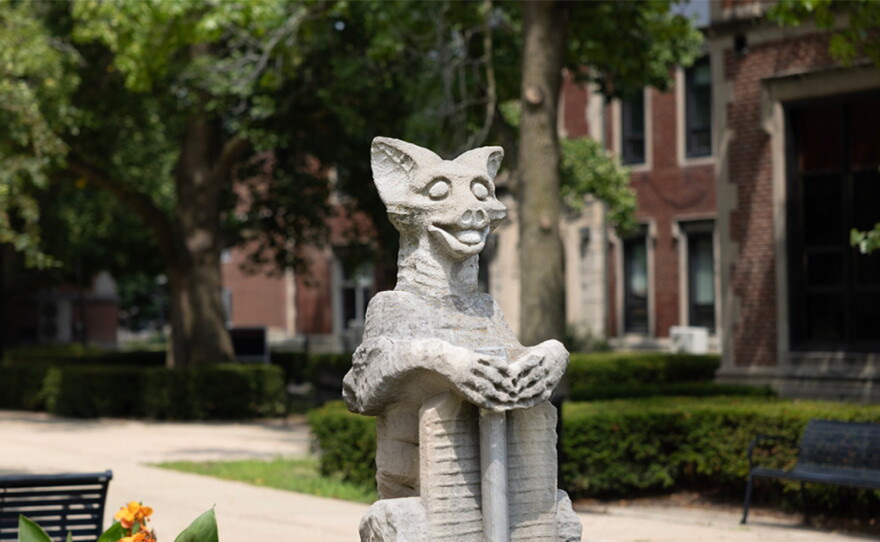
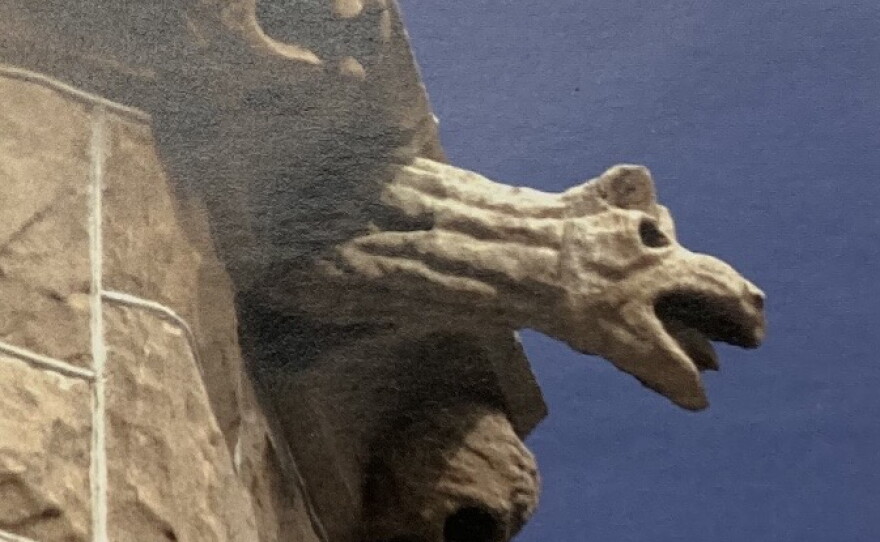
So, how did this “grotesque” find a permanent home in the flower beds, serving up smiles to NIU’s student body? And how did she get the name “Olive Goyle?”
When Northern Illinois State Normal School (now NIU) was founded in 1895, Illinois’ Governor was John Peter Altgeld.
Altgeld held the belief that public university buildings should be grand, ornate structures emblematic of the prestige of higher education.
Five historically inspired Gothic Revival castles were erected at Illinois’ public universities during Altgeld’s tenure as governor.
Northern’s “Castle on the Hill” was the university’s first academic building and was designed by Chicago architect Charles E. Brush in a Tudor Gothic style. It was completed in 1899.
Unlike Altgeld’s other university castles, Brush integrated gargoyles, griffins, owls, and grotesques into his final design to give the castle an authentically gothic flair.
Seven grotesques adorned the building’s central tower. Two overlooked the building's west wing and another two mirrored them on the east side.
The grotesque now known as “Olive Goyle” was once perched on a parapet above the building’s west entrance.

As legend has it, this same grotesque was severed from her perch by a lightning strike at the university’s first commencement on Jun. 21, 1900, only to be reattached not long after.
Despite this legend’s persistence in campus folklore, all we know for certain is that the day’s weather was characterized by “prolonged rainstorms.”
In fact, Altgeld Hall would retain all 11 of its original stone grotesques until sometime between 1930 and 1932.
Archival photos of the administrative building reflect the absence of a grotesque on the building’s central tower after this date.
It is believed that this grotesque, along with another in 1956, was damaged by a powerful gust of wind or a lightning strike.
Both of these statues were subsequently disposed of.
For a number of years, Altgeld’s grotesques held metal weathervanes, which may explain their susceptibility to lightning strikes.
During a particularly intense storm in July 1980 a grotesque, toppled from its perch by a lightning strike, punched a hole in the building’s roof and smashed a desk in the community college relations office.

“Olive Goyle” was the third grotesque to be removed from the building after she was struck by lightning 60 years ago today on Oct. 14, 1966.
According to a Northern Star article written five days later, the strike showered stone debris on the sidewalk below, prompting the closure of the building’s west entrance.
Fortunately, no one was injured and the statue was relocated to the university’s physical plant to assess the damage.
After it was determined that she could not be returned to her perch, the stricken grotesque sat quietly in storage for half a decade.
In 1971, growing interest in the grotesque’s whereabouts spurred the creation of a committee tasked with safeguarding the welfare of university artifacts.
Two years later, the University Historical Committee relocated the statue to its present site, affording students the opportunity to view a grotesque up close.
Then-University Archivist Joseph Bauxer told the Northern Star that the grotesque would be “as permanent as students allow it to be.”
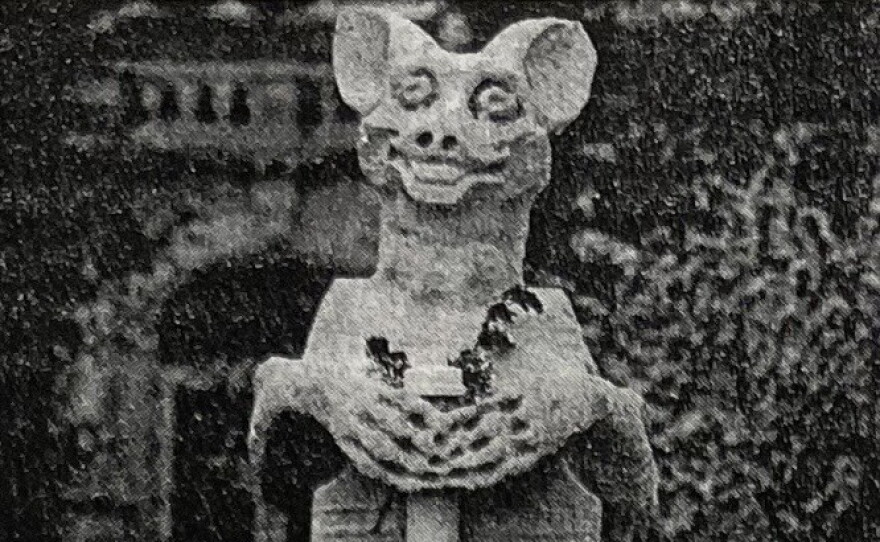
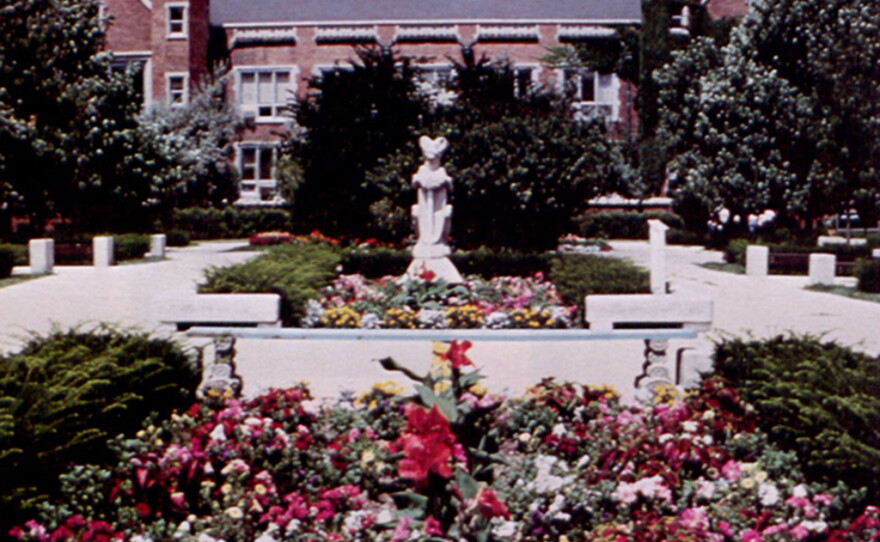
The statue’s presence on campus didn’t go unnoticed by students. In fact, she was so warmly received it was suggested that NIU athletics drop the “Huskies” team name in favor of becoming the NIU “Grotesques.”
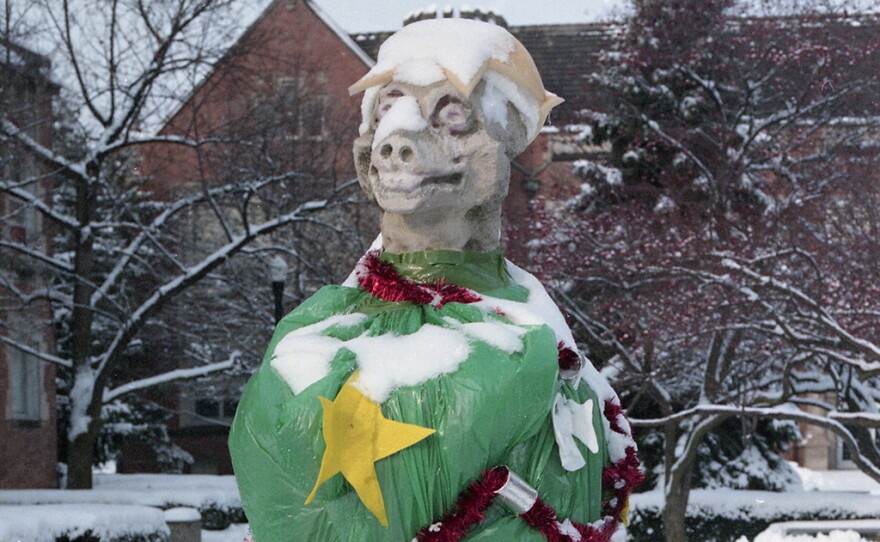
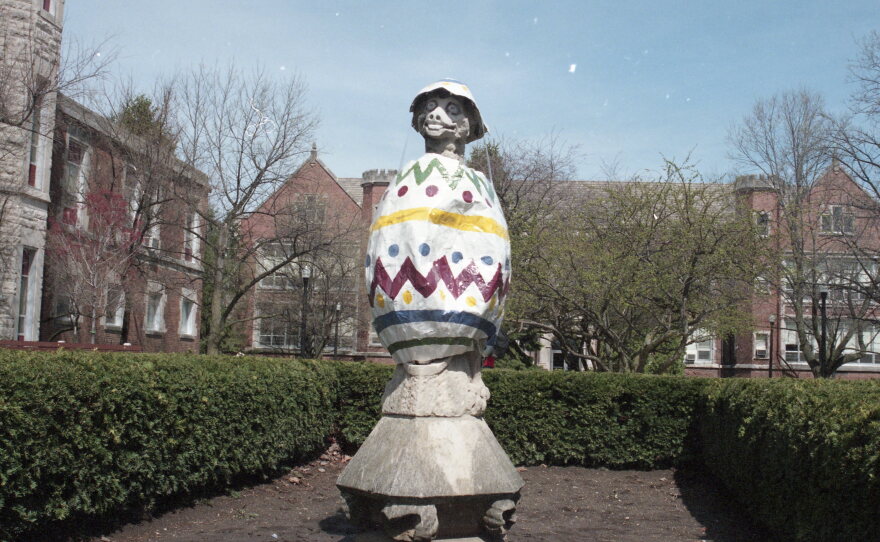
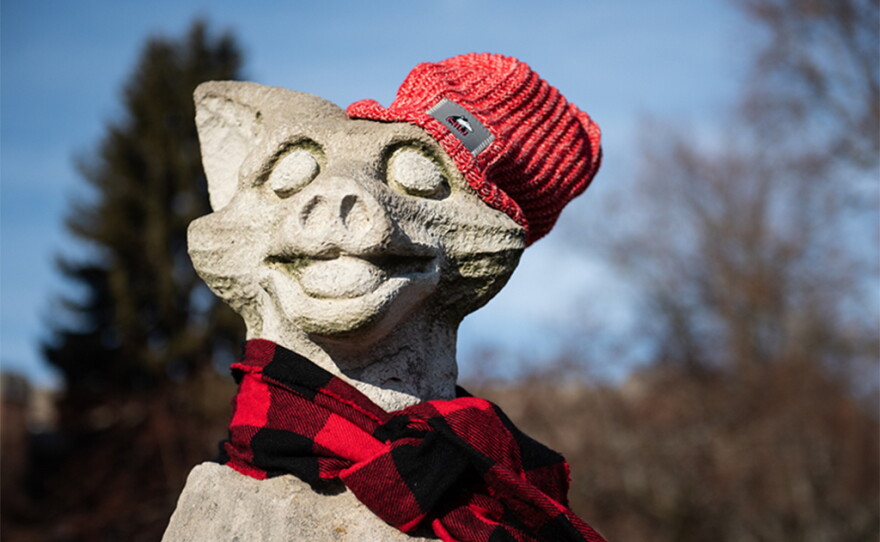
Costuming the grotesque to celebrate holidays, sporting events, and NIU’s annual homecoming became a popular ritual known as “dress-up pranks.”
The statue has donned many outfits during her tenure in Altgeld's mini-park. Below is a small collection of the stylish getups she's sported over the years.
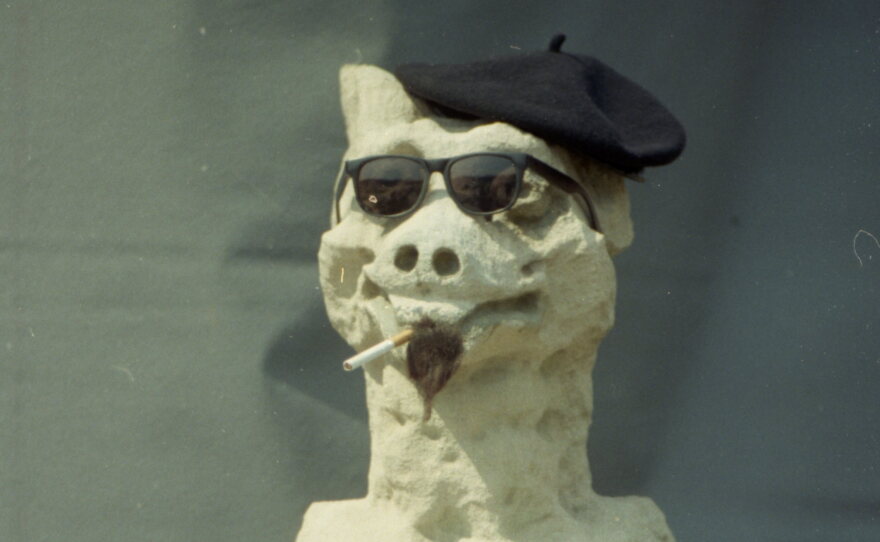
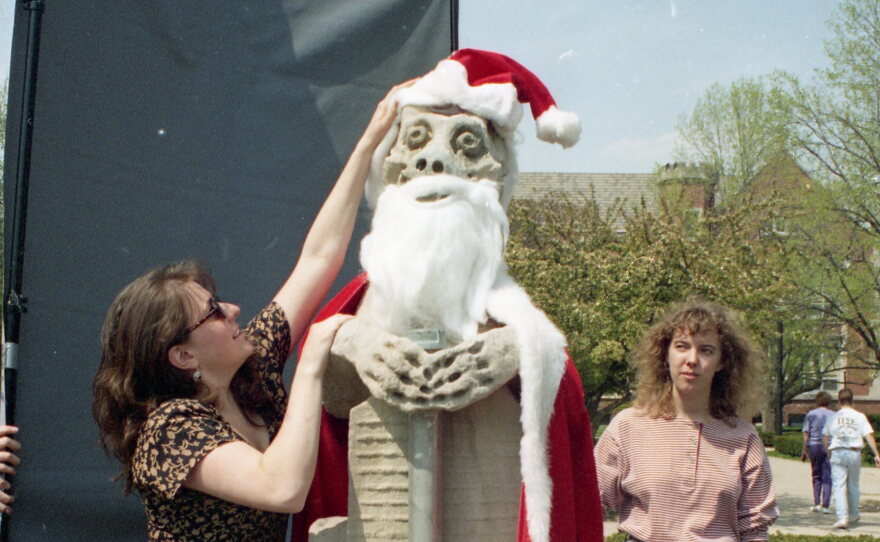
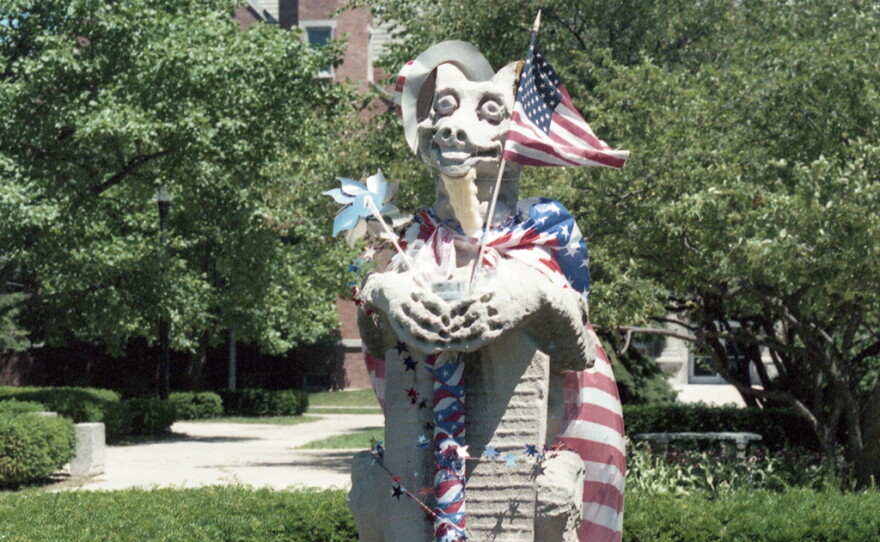
By 1986, the almost 90-year-old sandstone statue was now sporting noticeably cropped ears.
It is unknown whether this damage was caused by years of weathering, an accident, or an intentional act of vandalism.
The first documented case of vandalism targeting the statue occurred on Apr. 9, 1989, after she was found defaced with fluorescent green and yellow spray paint.
University gardener Robert Wallace told the Northern Star that statue pranksters had "never done anything like this" up to that point.
It would not be last act of vandalism to befall the poor grotesque.
In November 1995, the year of NIU's centennial, the university's art museum petitioned students to submit their ideas for a "Name the Grotesque Contest."
The contest was the brainchild of former NIU Art Museum Director Peggy Doherty and was organized by then-graduate student and future NIU Art Museum Director Jo Burke.
Over 150 submissions were whittled down to eight semi-finalists chosen by the museum's staff.
The second round of the contest, published by the Northern Star, resulted in a three-way tie between names "Phaethon," "Bob," and "Olivegoyle."
"Phaethon" refers to a tragic figure in Greek mythology who was killed by one Zeus' thunderbolts in order to prevent the end of the world.
And "Olive Goyle" is a playful pun on famous Popeye cartoon character Olive Oyl.
As for "Bob," the origins remain unknown.
The three contenders would once again go toe-to-toe in a final round of voting to determine the winner.
In February 1996, the Northern Star printed a cutout ballot featuring a checkbox and three appropriately dressed photos of the grotesque as each persona.
The contest officially closed on Mar. 7, 1996.

The winner of contest was announced on Apr. 2, 1996 in a Northern Star article entitled "Statue endowed with identity" by Grant Miller.
"Olivegoyle," stylized thusly, had come in first place with 24 votes. The runner-up "Phaethon" was narrowly bested with a final tally of 22 votes.
"Bob" came in a resounding third place with only five votes.
Jo Burke told the Northern Star in 1996 that it was "about time somebody gave it a name," adding "I certainly didn't know it was female."
Stories surrounding NIU's grotesques (especially Olive) continued to grace the pages of the Northern Star with the start of the new millennium.
Renovations made to Altgeld Hall in early 2001 saw the restoration of missing grotesques to the building's exterior. These replacement grotesques were made from castings of the original statues.
It was decided that after 30 years in the garden, Olive Goyle would not return to her original perch.
Instead, a replacement grotesque would take her spot above the west entrance.
It was a decision that would prove fateful that same year.

On May 12, 2001, while out on patrol, an NIU police officer made a grisly discovery in the Altgeld gardens.
NIU's famous grotesque was missing her signature smile, not to mention her entire head.
Having been severed by a chisel near the base of the neck, all that remained was a rebar column that reinforced the statue internally.
Footprints were found in the mud and photographs were taken by an officer using a disposable camera.
Some reports over the years have inaccurately claimed that this first beheading occurred in January 1996 or 2000.
A combination of photographic evidence and police reports do not corroborate these claims.
It would seem that this first investigation managed to recover and reattach poor Olive's head by June 2001.
A Northern Star article from 2006 suggests that the head was rediscovered the following morning outside Swen Parson Hall.
Suspicions naturally fell on university fraternities, but the decapitator(s) behind this first beheading have yet to be identified.

The key word here is "first," as poor Olive Goyle would only keep her reattached head for another four months.
On the night of Sept. 30, 2001, a campus security guard doing his nightly rounds discovered that the statue was once again without her head.
A few scuffed rocks and an overturned brick were found at the scene of the crime, but the grotesque's head was nowhere in sight.
The second beheading struck higher up on the statue than the first, just below her chin.

In an effort to see the head returned, The Northern Star launched a second naming contest in October 2001.
While this second contest failed to facilitate the head's return, it did succeed in renaming the statue.
For a period of time in the early 2000s, she was named "Homer J. Goyle" as an homage to NIU alum Dan Castellaneta, the voice of Homer Simpson.
While the statue had been re-united with her severed head after the first attack, the same would not be true of the second.
To this day, the perpetrator(s) and poor Olive’s original head remain at large.
For over a decade, Olive would remain a headless fixture in the university gardens.
The sight of the de-blocked statue naturally inspired students to craft temporary heads for her over the years, oftentimes out of snow or carved pumpkins.
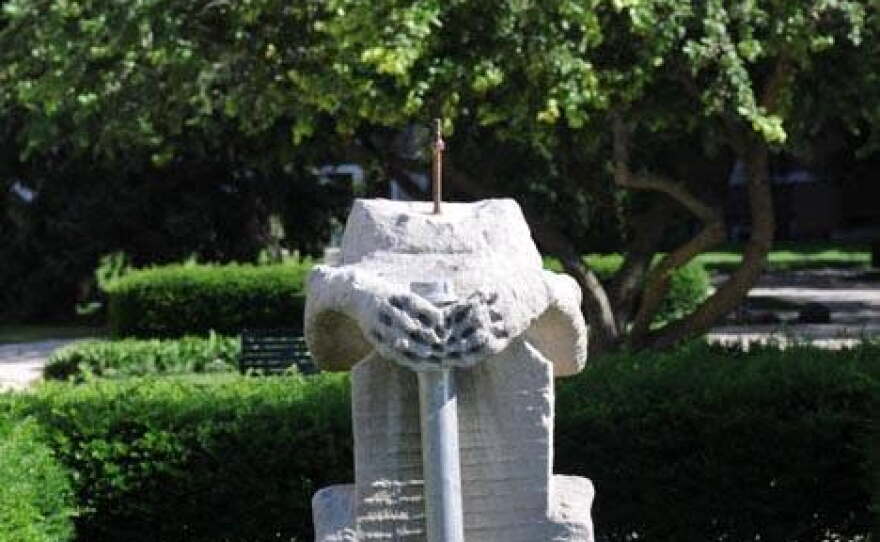
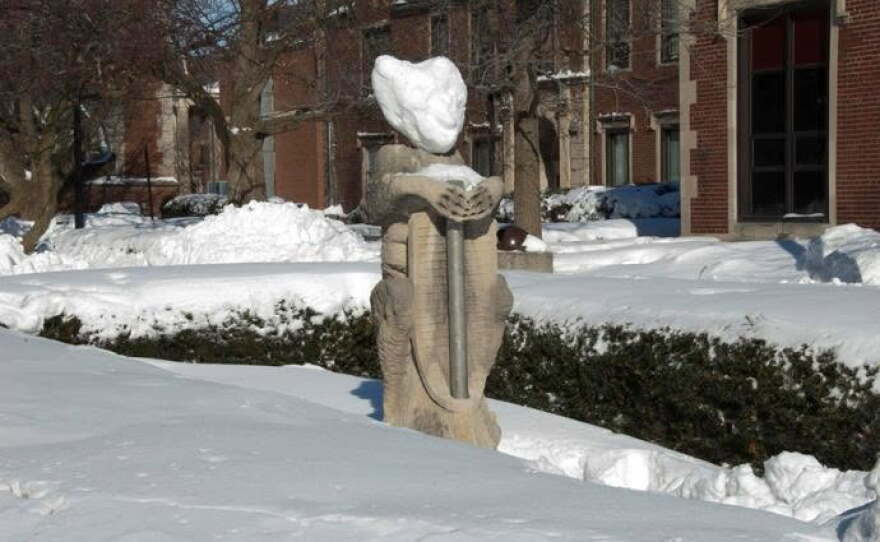
It wasn't until June 2013, that Olive received a new head courtesy of Vanguard Sculpture Services, Ltd in Milwaukee, WI.
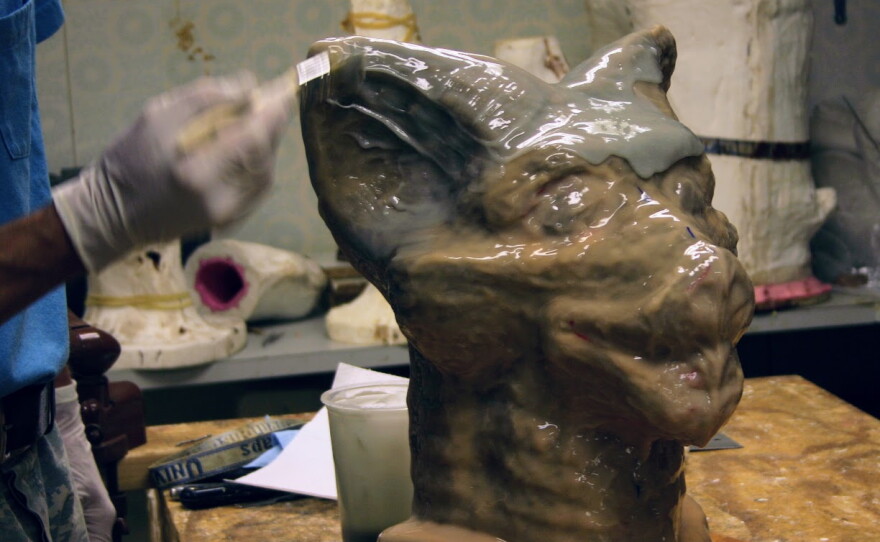
According to Vanguard's President and owner Beth Sahagian-Allsop, Olive's new head, made of concrete, was first sculpted from clay using reference photos of another rooftop grotesque.
"[The university] wanted it to look as much like existing gargoyles as we could make it," said Sahagian-Allsop. "Our job is to faithfully reproduce that sculpture in another material. So that’s essentially what we did, except we made the model."
The process of photographing, sculpting, casting, and installing a new head took about a month, and Vanguard still retains the mold in the event of another beheading.
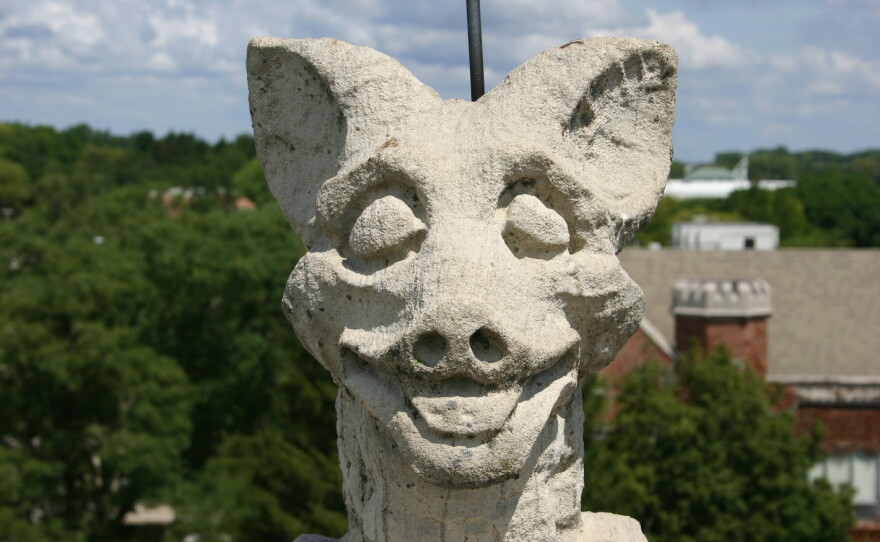
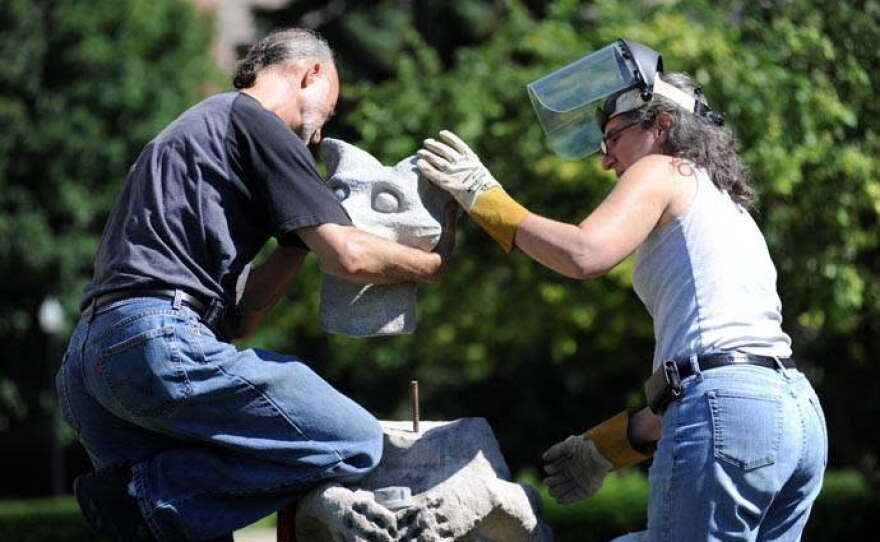
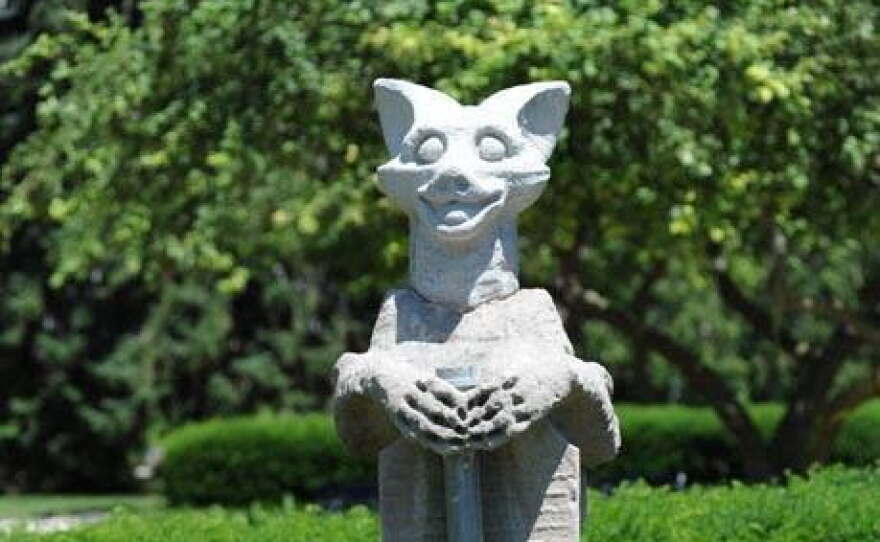
With her smile restored, Olive continues to mark time as a weathered sentry overlooking the intersection of Castle Dr. and College Ave.
She’s commonly featured in graduate photo shoots, and the NIU foundation has a loyal society for university donors named in her honor.
So, next time you take a stroll through the lagoon, make sure to stop by and pay Olive a visit.
Even after 60 years of dress-up pranks, lightning strikes, and general misfortune, she’ll gladly offer her signature grin as you pass by.