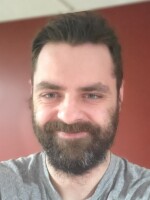
A Pekin pastor is calling for less automated moderation of internet content and for organizations to back up their history after his church's YouTube channel was deleted without warning.
Nathan Noyes, pastor of Gethsemane Church in Pekin, went to YouTube in June to upload recent church videos only to discover YouTube deleted Gethsemane's channel. It allegedly violated the site’s spam, deceptive practices and scam policy. Countless videos — documenting church activities and history — were lost.
Noyes is advocating for more humans reviewing internet-content appeals not just so this does not happen to others but because he thinks it is better for free speech.
“Free speech is how we have conversations and even debates, and find out what is the truth,” Noyes said. “If we shut down [and] have this cancel thing where you just cancel somebody and then don’t even [give] a reason, I really think that’s un-American, and it’s a travesty.”

Noyes received no warnings or strikes before YouTube took down the channel.
Noyes reached out to YouTube in several different ways, but his appeals were repeatedly denied.
“We’re flagged because of AI, and then we’re responding to AI, and AI responds back to us, and it’s like we can’t get to a real person," Noyes said. "So, it’s very frustrating.”
While he did not think they would violate YouTube policy, new AI thumbnails on old videos are the only element Noyes could see causing a problem with the automated YouTube moderation system.
A representative of YouTube told WCBU after this story published that it has since restored Gethsemane Church's channel and indicated that it violated YouTube's current spam policy.
The church’s channel was around 15 years old with over 2,000 subscribers and thousands of videos. It featured sermons, Bible teaching, worship services, baptisms, missionary presentations, vacation Bible school programs and choir music among other church content and history.
Susan Kaufman, a Peoria local history genealogy librarian with 40 years’ experience, said preserving family and local history gives someone a sense of self. It allows people to learn about where they live and about their origins from a local and personal perspective.
“And it helps you directly experience the past,” Kaufman said. “A personal and a societal past. I love giving people…I guess, ideally, it might be an identity, I suppose….”
Maureen Naughtin, curator of the Peoria Historical Society since 2018, said we all need to know our history.
“There’s the line about history repeating itself, which, unfortunately, we see that,” Naughtin said. “We see patterns, but if we’re aware of our history, we can hopefully take steps to either replicate the good in our history or try to reduce [or] stop some of the bad in our history. I feel any sense of awareness of where we’ve been only helps us moving forward in our future.”

Gethsemane’s videos were not just pieces of the church’s more than 50-year history, they were ways to connect with a community in and outside of Pekin.
“We serve not just the people in our church,” Noyes said. “But there are people who are shut-ins who would watch us, and I’ve had people from other countries [watch us]. We’ve got a guy from Australia [who] watches us very regularly.”
Copyright infringement
Bradley University communications department faculty member David Lennie is involved in media production at the college. For over a decade, he has also digitized video tapes for people in his spare time.
Lennie has produced Peoria’s annual St. Jude telethon for the past four years and has been involved in every area of production for the past 32. With the event reaching its 50th anniversary next year, preservation is more important than ever as the telethon looks back via old tapes and splices them together with new footage to see how far cancer treatment has come.
Lennie is not surprised by the church’s predicament.
“I think the most frustrating part about YouTube — and I don’t know if there’s really a fix for it — but YouTube and other giant video sharing companies like that, is that you’re up against robots most of the time, and it is difficult to get a human being to look at your case,” said Lennie.
A problem Lennie ran into was live-streaming concerts from the university’s Dingeldine Music Center. Lennie said they were able to do good quality streams with a three-camera setup, but they had to walk away from YouTube as a concert hosting platform five years ago.

Even if Bradley paid for the rights to stream the music or got permission from the composer, “the first thing you’re up against with YouTube is a robot,” said Lennie, “and the robot just says, ‘That’s copyrighted stuff, and you can’t stream that.’ Bang. ‘Shut it down.’
"By the time you get a human being to look at that, if you even can, it is too late.”
Bradley now uses a custom server setup from a local company that allows them to stream the concerts. The upside is the university does not need to worry about copyright bots. The downside is the streams are not saved, and viewers must catch them when the events are live.
While he continues fighting for the YouTube channel’s reinstatement, Noyes is uploading new and old content to Rumble and slowly building Gethsemane’s audience back.
Rumble is a Canadian-American online video platform, web hosting and cloud services business that hosts Truth Social, the social media site majority owned by President Donald Trump.
It is disheartening, Noyes said, to lose the videos and an audience who he, for the most part, has no way of contacting to steer them towards a new video platform for the content.
“I’m not bitter,” Noyes said. “I’m not angry. Disappointed, yes, and I’m fearful of the future for those who do not have their content backed up.”
Noyes used multiple hard drives to back up his father’s sermons when he was Gethsemane’s preacher. When Gethsemane moved to its current building at 600 State St., the church changed certain processes and stopped copying videos onto hard drives.
Noyes thought he would be safe with everything hosted only on Facebook and YouTube, but in early 2025, Facebook stated it would only store live streams for 30 days before deleting them.
“We had it backed up on two platforms, but then when Facebook stopped, we lost it there and didn’t think about backing up our YouTube,” Noyes said. “We should’ve done that. We didn’t do it. Shame on us."
Noyes lost three years of material in the sudden channel deletion, but he still has about 12 years of content on hard drives. With Facebook becoming unusable in the long-term due to its storage restrictions and YouTube unreliable due to its automated systems, Noyes will be more vigilant about backing up future content.
To archive his content, Lennie utilizes a sizeable network-attached storage device and offsite storage that he updates yearly.
Genealogy preservation
The Peoria Public Library’s Local History and Genealogy Department [LHGD] currently stores its digital historical material on familysearch.org and the Genealogy Center at the Allen County Public Library in Fort Wayne, Ind. The library has a five-year plan to develop its own system where they can store material on its website. While it is a multi-year plan, Kaufman said she hopes something can be worked out over the next 18 months.
For public use, the LHGD also has a flatbed scanner that can scan up to six photos at a time. It allows someone to record information about photos before the library digitizes the images and audio onto a flash drive or external hard drive that people take home. The same service is offered for slides, where people can scan 80 slides at a time.

People can also do slight restoration work using the library’s Vivid-Pix restoration station.
Kaufman said people or organizations interested in specifically family history preservation should set up an account on ancestory.com, which charges for a subscription, and familysearch.org, which is free.
People can also utilize their OneDrive or Google Drive.
“The whole idea is making it accessible for the family and making it as perpetual as possible,” Kaufman said. “You can pass down a flash drive, right? Just like you can pass down the boxes of [physical material]…but will that flash drive live? So, if it’s important, where can you make it live?”
Kaufman stressed people should not underestimate the knowledge of their local librarian either. She said as the internet has become such an important and powerful tool to look up and learn about history, fewer people come into their local library and utilize staff who may know information they are struggling to find.
The processes by which the Peoria Historical Society [PHS] preserves and shares local history have changed over recent years, said Naughtin. PHS is catching up to 21st century technology, but in regards to digitization, they are getting a system down: New materials arrive; that day, Naughtin will assign a volunteer to catalogue and someone to scan; and the material is fully digitized and uploaded to the PHS’s website for anyone to see.
While some material is stored on iCloud to help move it between hard drives, PHS stores most of its content on a local hard drive. PHS recently expanded the drive’s memory, and the organization also has some external hard drives at Bradley’s special collections center.
Naughtin recommends designating someone to get on storing historical or family content as soon as possible, because you never know. She also said to “Digitize, digitize, digitize.” Have as many copies as possible by saving it to multiple places: A USB, an external hard drive, a CD, etc. She also recommends not throwing physical materials away after digitization.

But whatever tools or devices people have access to, Lennie recommends they do something: Back it up somehow, pay a few dollars extra for more iPhone storage or Google Drive space, etc.
He also suggests people have a plan for what happens to their digital footprint after they are gone. People should share their passwords with a trusted friend or family member so their media can still be accessed after they die, he said.
“There’s a lot of options out there,” Lennie said. “But figure out how to get your content out of your phone and up somewhere, and tell your loved ones how to get to it and what you want done with it after you’re gone.”
Kaufman thinks preservation will always be around, “because humans are historically oriented” and they care about the past.
“Sometimes I think we live in a vacuum, and we wonder sometimes how we got here,” Kaufman said, “and if we spent a little time, maybe, sitting outside of ourselves and looking at society and maybe our family, we might realize how we got here.”