
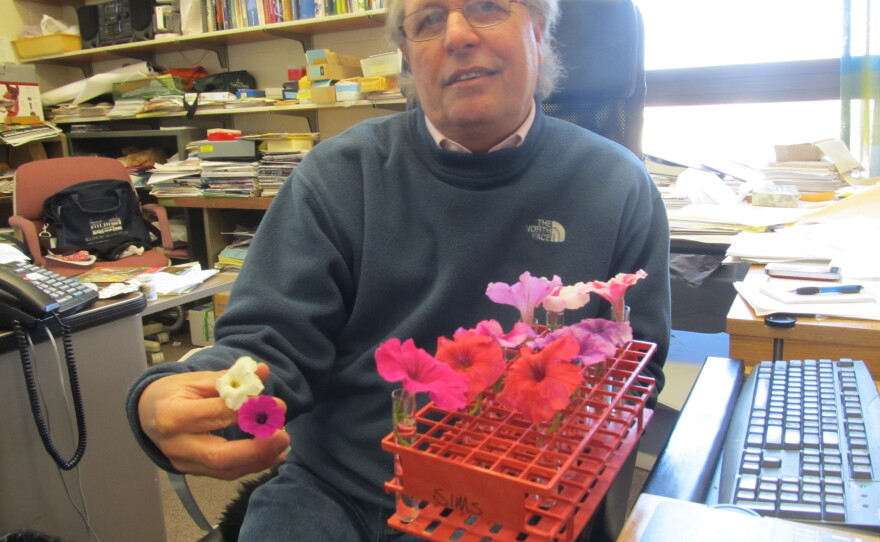
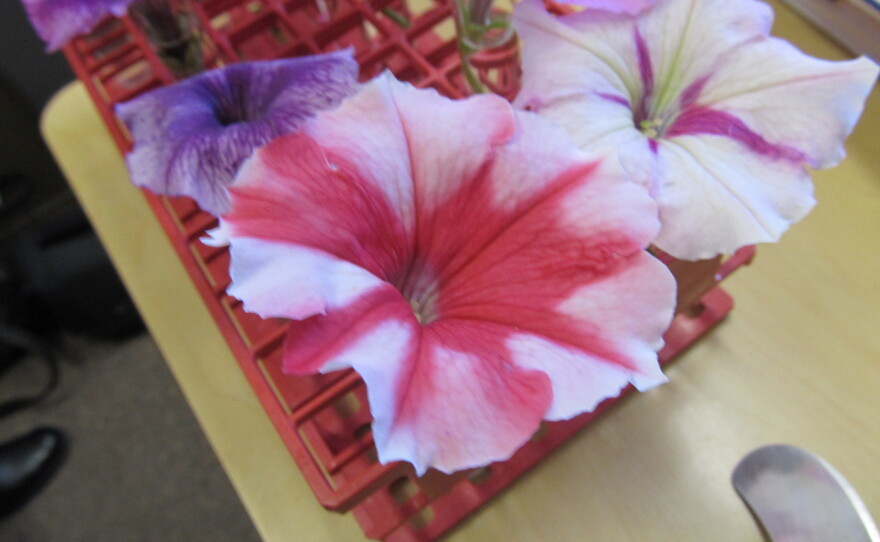
Petunias are planted in gardens around the world. Some are striped like candy canes, others come in shades of pink or purple. They may seem like simple flowers, but petunias are actually quite complex.
Northern Illinois University biology professor Tom Sims coordinates the Petunia Genome Project, an effort to sequence the DNA of the popular flower.
"People have worked on petunias as a model system for understanding basic plant biology since Darwin. He was actually one of the first people to work on petunias and they've been used for decades," Sims said. "It's easy to grow, there's a lot of variety in terms of the development and the biochemical pathways that you find in a petunia."
Northern Now: DNA Sequencing in Full Bloom
By understanding the genes in the plants, researchers hope to uncover information that could be useful to manipulate genes in other common crop plants like tomatoes and peppers which could aid in their future development. In other words, better tasting fruits and vegetables.
Some species are unable to fertilize themselves, an occurrence known as "self-incompatibility." Researchers hope to use petunias as a model to understand why this happens. That information could be used in fruit-bearing trees.
The sequencing also helps identify trait genes responsible for smell, color, and lifespan. So far, researchers behind the Petunia Genome Project have nearly sequenced two wild varieties of the plant. To do so, NIU researchers extract DNA information from the leaves and analyze that information on high-speed computers.
"It's often hard to make molecular biology visually interesting. It's intellectually fascinating, there's a lot of cool stuff that goes on, but it doesn't always lend itself to great pictures," Sims said.
Sims says mapping the petunia genome is far from completion, and he does not expect it to be finished within his lifetime, even though he has already contributed 25 years to studying the flower. Sims says getting an initial DNA sequence for an organism is really only the starting point.
"In addition to trying to understand these puzzles, and trying to understand some basic biological principles, we're also training a new generation of scientists. And yes, those students are working on petunia or petunia genomes, but they are going to be able to take that knowledge, and that training, and work on many, many other systems."